


Key takeaways
- SVOD stands for Subscription Video on Demand, a streaming model where viewers pay a recurring fee for access to a library of video content.
- SVOD gives viewers control over what they watch and when, typically across multiple devices.
- For streaming providers, recurring subscriptions can create predictable revenue and direct customer relationships.
- Subscriber acquisition, engagement, retention, and churn are critical to the success of an SVOD service.
- Many media companies now combine SVOD with advertising, FAST, or transactional models to create more flexible hybrid propositions.
Subscription services helped define the modern streaming era. Instead of following a fixed TV schedule or purchasing individual programs, viewers gained access to entire content libraries for a recurring fee.
This model is known as SVOD, or Subscription Video on Demand.
For OTT providers, broadcasters, and media companies, SVOD provides a way to build direct relationships with audiences and generate recurring revenue from premium content.
But as competition increases and viewer expectations evolve, running a successful SVOD service requires more than putting content behind a subscription.
This article explains what SVOD is, how it works, how it compares with other streaming business models, and what operators need to build a successful subscription streaming service.
What is SVOD?
SVOD stands for Subscription Video on Demand.
It is a streaming business model where customers pay a recurring subscription, typically monthly or annually, in exchange for access to a library of video content.
Unlike traditional linear television, viewers aren't required to follow a programming schedule. They can select what they want to watch and stream it on demand.
SVOD services commonly provide:
- On-demand movies and series
- Original or exclusive programming
- Multi-device access
- Personalized recommendations
- Multiple user profiles
- Ad-free or reduced-ad experiences
Well-known examples of services built around SVOD include Netflix and Disney+.
However, SVOD isn't limited to global entertainment platforms. Broadcasters, sports organizations, niche content owners, and regional media companies can also use subscriptions to monetize their audiences directly.
How does SVOD work?
The SVOD model is relatively simple from the viewer's perspective: subscribe, sign in, choose content, and start watching.
Behind the scenes, several technologies and workflows need to work together.
1. Subscription and registration
The viewer creates an account, selects a subscription plan, and provides payment details.
2. Authentication and entitlement
When the viewer signs in, the platform verifies their account and determines which content their subscription allows them to access.
3. Content discovery
A content management system, search functionality, metadata, and personalization help viewers find relevant programming.
4. Video delivery
Selected content is delivered over the internet, typically using adaptive bitrate streaming and a Content Delivery Network (CDN).
5. Playback and content protection
The video player delivers the viewing experience, while technologies such as Digital Rights Management (DRM) protect premium content.
6. Analytics and engagement
The platform collects data about content consumption and service performance to help operators understand engagement and improve the experience.
A successful SVOD proposition depends on all these components operating as one connected service.
How do SVOD services make money?
The primary source of revenue for an SVOD service is recurring subscription fees.
Operators may offer several pricing options, such as:
- Monthly subscriptions
- Annual subscriptions
- Premium tiers
- Family plans
- Bundled subscriptions
This recurring model can provide more predictable revenue than business models based exclusively on advertising or individual transactions.
However, profitability depends heavily on the relationship between acquisition costs, subscription revenue, and how long customers remain subscribed.
This makes metrics such as Customer Lifetime Value (LTV), Customer Acquisition Cost (CAC), and churn particularly important.
The longer customers remain engaged and subscribed, the greater their potential lifetime value.
SVOD vs AVOD: what's the difference?
SVOD and AVOD represent two different approaches to monetizing streaming content.
SVOD generates revenue primarily through subscriptions.
AVOD (Advertising Video on Demand) gives viewers access to content funded primarily through advertising.
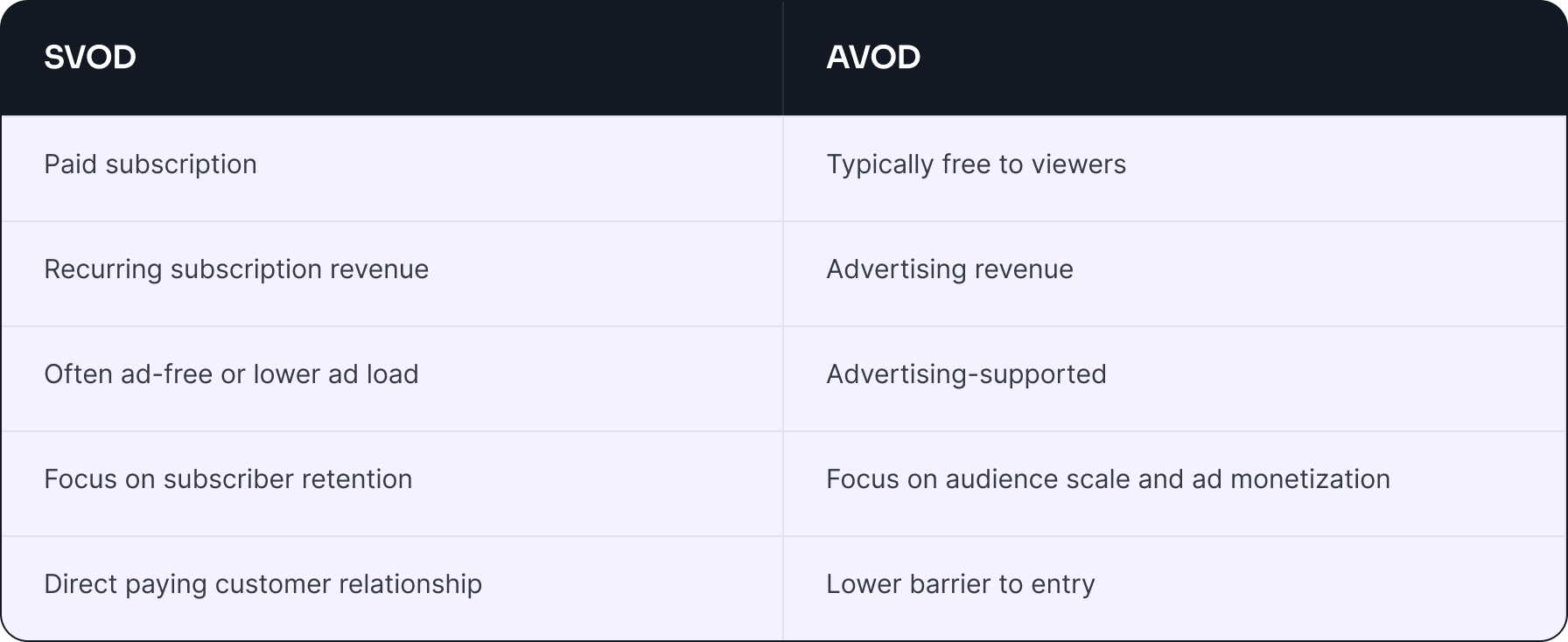
Neither model is inherently better. The right choice depends on the audience, content, market, and commercial strategy.
SVOD vs FAST
SVOD also differs from FAST (Free Ad-Supported Streaming TV).
FAST typically offers free, advertising-supported linear channels, while SVOD primarily provides paid access to an on-demand content library.
The viewing behavior is also different.
With SVOD, viewers actively select individual programs.
FAST provides more of a traditional "lean-back" television experience, where viewers tune into an existing programming schedule.
Increasingly, operators are combining both models within broader streaming propositions.
The rise of hybrid SVOD models
The boundary between subscription and advertising models is becoming less rigid.
An SVOD service doesn't necessarily have to be completely ad-free.
Streaming providers can offer multiple tiers, for example:
- A lower-cost subscription with advertising
- A premium ad-free subscription
- Free FAST channels
- Transactional premium content
This hybrid monetization approach gives viewers more choice while enabling operators to diversify revenue.
Rather than asking whether SVOD or advertising is the better model, media companies can determine which combination best suits different audience segments.
Benefits of SVOD for streaming providers
SVOD remains attractive for several reasons.
Predictable recurring revenue
Subscriptions can create a relatively consistent revenue stream and make financial forecasting easier.
Direct audience relationships
Direct-to-consumer subscriptions allow operators to build their own customer relationships rather than relying entirely on third-party distribution.
First-party audience data
With appropriate user consent, operators can better understand how subscribers interact with content and the service.
Personalization
Account-based viewing enables more personalized recommendations, interfaces, and content discovery.
Customer lifetime value
Strong engagement and retention can increase the amount of revenue generated from each subscriber over time.
Challenges of the SVOD model
SVOD also presents significant challenges.
Subscriber acquisition
With many services competing for attention, convincing viewers to add another paid subscription can be difficult and expensive.
Churn
Customers can often cancel subscriptions easily, making retention a constant priority.
Content investment
Subscribers expect a compelling and regularly refreshed content proposition.
User experience
Poor content discovery, buffering, application issues, or inconsistent multi-device experiences can quickly undermine perceived value.
Subscription fatigue
Consumers have a finite entertainment budget, increasing pressure on services to demonstrate why they deserve an ongoing subscription.
These challenges make engagement just as important as acquisition.
What makes a successful SVOD platform?
A strong SVOD proposition combines compelling content with a technology platform designed around the subscriber lifecycle.
Key capabilities include:
Content management
Operators need to manage content, metadata, imagery, availability, and rights efficiently.
Multi-device delivery
Subscribers expect consistent access across smart TVs, mobile devices, browsers, tablets, and connected devices.
Personalization
Relevant recommendations help subscribers discover value within the content library.
Reliable playback
Fast startup times, high video quality, and minimal buffering are fundamental to the experience.
Analytics
Audience insights help operators understand engagement, content performance, and subscriber behavior.
Flexible monetization
The platform should be able to evolve beyond a single subscription model as commercial requirements change.
SVOD within 24i Video Cloud
At 24i, subscription services are treated as part of the wider streaming ecosystem rather than simply a payment model.
24i Video Cloud brings together capabilities across applications, content management, video workflows, personalization, monetization, and data to help OTT providers, broadcasters, and Pay TV operators build and evolve direct-to-consumer services.
This connected approach can help operators:
- Deliver subscription experiences across multiple devices
- Manage content and metadata from a centralized environment
- Personalize content discovery
- Support secure premium video delivery
- Understand audience engagement through data and analytics
- Combine subscriptions with advertising and other monetization models
This flexibility is increasingly important as streaming businesses move beyond pure SVOD toward more diversified propositions.
Rather than rebuilding the technology stack when the business model changes, operators can evolve the service alongside audience and market requirements.
The future of SVOD
SVOD isn't disappearing, but the model is evolving.
Subscription-only growth is becoming harder in increasingly competitive markets, encouraging operators to focus more heavily on profitability, retention, and revenue diversification.
Several trends are shaping the future of SVOD:
Hybrid monetization
More services are combining subscriptions with advertising-supported tiers and other revenue models.
Greater personalization
AI and first-party audience data can help services make content discovery more relevant to individual subscribers.
Focus on retention
Reducing churn and increasing customer lifetime value will remain critical as subscriber acquisition becomes more expensive.
Bundling
Media and telecommunications providers can combine streaming services with other products to create broader customer propositions.
Operational efficiency
Operators will increasingly look for ways to simplify technology stacks and reduce the cost of delivering and maintaining streaming services.
The strongest SVOD strategies will therefore focus not only on acquiring subscribers, but on creating sustainable value from those relationships over time.
Conclusion
SVOD transformed the way audiences access premium video and remains one of the most important business models in streaming.
By providing on-demand content in exchange for recurring subscription fees, it gives operators an opportunity to create predictable revenue and build direct relationships with viewers.
But success increasingly depends on more than subscriptions alone.
Content discovery, personalization, video quality, multi-device delivery, retention, and flexible monetization all influence whether subscribers continue to see value in the service.
With 24i Video Cloud, operators can bring these capabilities together within a connected streaming ecosystem, providing the foundation to launch, manage, and evolve SVOD services while remaining flexible enough to embrace advertising, FAST, and hybrid monetization strategies.
FAQs
What does SVOD stand for?
SVOD stands for Subscription Video on Demand, a streaming model where viewers pay a recurring fee to access video content on demand.
How does SVOD work?
Users subscribe to a service and gain access to a content library that they can watch on demand across supported devices. The provider generates revenue primarily through recurring subscription fees.
What is the difference between SVOD and OTT?
OTT refers to delivering video over the internet rather than through traditional broadcast infrastructure. SVOD is a specific monetization model used by many OTT services.
What is the difference between SVOD and AVOD?
SVOD is primarily funded through viewer subscriptions, while AVOD is primarily funded through advertising and is typically free or lower-cost for viewers.
What is the difference between SVOD and FAST?
SVOD generally provides paid, on-demand access to content. FAST typically provides free, advertising-supported linear channels delivered over the internet.
Can an SVOD service include advertising?
Yes. Hybrid services can offer lower-priced ad-supported subscription tiers alongside premium ad-free plans.
What are the main challenges of SVOD?
Common challenges include subscriber acquisition costs, churn, subscription fatigue, content investment, and maintaining a high-quality experience across devices.
How does 24i support SVOD services?
24i Video Cloud connects applications, content management, video workflows, personalization, monetization, and data to help operators build and evolve subscription-based streaming services across multiple devices.


